MAP TO LOSE YOURSELF / INDIA 4 HOLY SITES

Map to lose yourself Produced in 2009 at the dawn of the digital age, Map to Lose Yourself is a trilogy to which online users gave instructions, prompts, over the unstable infrastructure of Indian internet cafes. The live performer followed their instructions through four holy Indian cities. All conversations, actions, experiences and visuals were fed back into the digital interface using an algorithm that translated them into information objects. The catharsis of the project was a self-immolation on the sacred ghat of the Ganges River in Varanasi, Manikarmika.
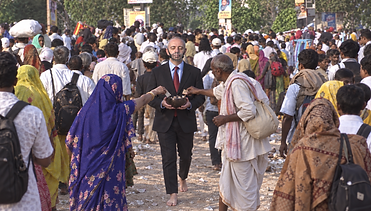


His flight through India’s holy cities, clad in a European business suit, is inspired by the ancient hero Orestes—pursued by the Erinyes, the hallucinations of a chaotic conscience following severe trauma. This hero is a former warrior seeking a map or a path to inner peace—a way to lose himself. His Erinyes are digital prompts arriving at every moment from the other side of the globe; strangers send him instructions on what he must do. The digital chaos of these "Erinyes 2.0" ultimately leads him to the sacred Manikarnika Ghat on the Ganges, where he must be consumed by fire.

This is not a picture. This is movement through a picture. There is Money Baba, who collects banknotes. A taxi driver in New Delhi who physically attacks us. A friend whose brother committed suicide. Boys from Bodh Gaya sliding with me along the path in front of the world's largest Buddha. A grandmother from Bihar who refuses money if she tells us her life story. A Tibetan monk who barely saved himself from suicide while in a camp. The Oracle’s prophecy about my life. Plunging into the Ganges three times in Haridwar.
INDIA / TRILOGY ABOVE: Prompt aplication (Screenshoot). RIGHT: Final object - icon painted by human hands: reception becomes meaning! Zarilli writes about this as a form of oral performance, heroic/epic stories that do not have a fixed text, but rather each performance is systematized as it happens, and the mechanism of memory is actually a highly creative process that involves shortening and scanning in order to merge the story into a whole performance (Zarilli 2010: 18). It is also interesting how Zarilli describes the viewer or, better, the listener of created mythical words in primarily oral cultures: “The listener does not try to analyze, understand or interpret what he hears, but experiences and absorbs the musicality of the voice, timbre, tone, pitches, resonance, vibration and shape as the voice moves between sound and silence (…) Reception is perception, not ‘meaning’.” (Zarilli 2010: ibid.).


