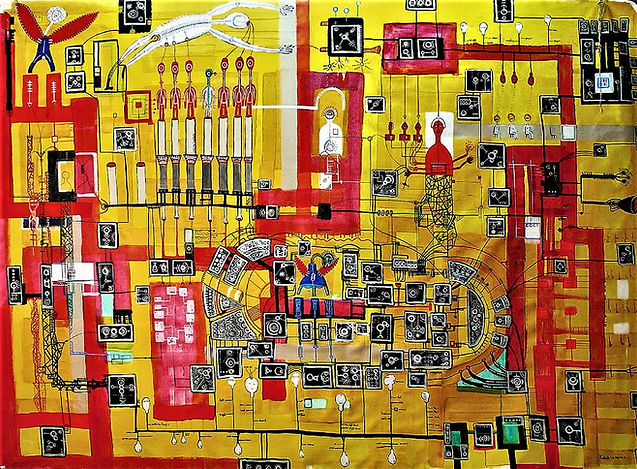
MACHINEHAUS / BERLIN painting: C.E.R.N. WITHIN
The artist moves with measured steps between computers, printers, various screens that emit data, telephones and other communication devices, and transfers all the data he extracts from the technology manually onto a large two-dimensional surface, thus creating a visual representation in multiple colors and shapes, and according to a principle or interpretation known only to him. The insistence that this is a scientific research project is also reinforced by emphasizing the project name Within the CERN, after the Swiss institute for the study of subatomic particles, CERN. The visualization process is taken from the method of detecting subatomic particles as carried out at the CERN institute, where, in the underground of kilometer-long tunnels full of magnetic impactors, subatomic particles are detected from the traces they leave in deliberately caused collisions. The collision traces are recorded in a visual representation of the data, and then this visual representation is analyzed in order to detect the presence of the desired subatomic particle. Namely, each particle leaves a different trace in a collision with another specific particle. The Berlin-based performance group MachineHaus most often forms performance functions that correspond to patterns from computer games or popular culture in general, or even forms hybrid functions, such as “Permanent Doubt”, “Hysterical Warrior”, “Computer No/Man”, etc. Members of the performance group are obliged to align all their actions, performances, presentations and subsequent analyses with the function they carry. This practically means that they will maintain interaction in encounters at certain places that we have chosen as performance spaces in the manner of their function, regardless of real needs or even physical danger. The very way of playing out the functions was left to the performers themselves, who established acting action from the marked functions and thus created the situation. The functions ensured the characters the development of a kind of dramatic task, the implementation of a prescribed pattern in interaction with any entity, human or machine. The machine entity did not necessarily have to be a digital machine or a cybernetic being. It could also be, for example, a set of police rules on behavior in a certain situation or in a certain place, which was recognized by its active role in the dramatic situation – namely, it had to be overcome, strategies, dialogues, tactics to neutralize the resistance it offered. For example, the water war (German: Wasserkrieg) was a real war, but waged with water, fruits and vegetables, and took place on the bridge between the Berlin districts of Kreuzberg and Friedrichshain. The group of performers of the MachineHaus project receives instructions – functions: “Warrior waging war against all,” “Recipient of blows to the head,” “Balkan glossolalia,” “Imperialist American,” etc. An individual performer or group would label themselves with such functions and perform in accordance with them towards the participants in the event who are spectators, audience, passers-by, etc., all of which would cause the effect of surprise and transformation into a performance situation that is subsequently described and further elaborated on in the digital interface.


Describe your image

Describe your image


